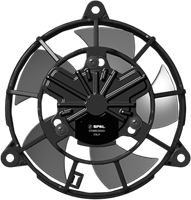
Brushless Cooling Fans for Efficient Thermal Management
Brushless cooling fans are an essential component of modern thermal management systems. Combining electronic motor commutation, adjustable operating speed and high airflow performance, these fans are suitable for applications where cooling capacity must respond to changing operating conditions.
At QSP Products, we offer a range of brushless fans for automotive, motorsport and technical cooling applications. Our selection includes 12V and 24V configurations for radiators, heat exchangers and custom cooling installations, allowing the fan to be matched to the electrical system and required thermal performance.
Brushless Motor Construction and Operation
Conventional brushed DC motors use carbon brushes to provide electrical commutation. A brushless motor performs this function electronically using an integrated control system.
By eliminating mechanical contact between carbon brushes and a commutator, brushless motor technology avoids brush-related wear and enables precise electronic control of the motor's operating speed.
This makes brushless fans particularly suitable for cooling systems that require variable airflow throughout different operating conditions.
Airflow Performance and Static Pressure
Airflow capacity, usually expressed in m³/h, is an important specification when selecting an electric cooling fan. However, maximum airflow alone does not determine the fan's performance within a complete cooling installation.
Radiators, condensers and heat exchangers create resistance to airflow. This resistance produces static pressure, which affects how much air the fan can deliver through the cooling core.
Actual airflow is determined by the interaction between the fan's performance curve and the pressure resistance of the system. Factors such as radiator thickness, fin density, mounting arrangement and airflow ducting can all influence the result.
For accurate fan selection, we recommend evaluating the pressure versus airflow performance curve rather than relying exclusively on the maximum free-air rating.
12V and 24V Brushless Fans
Our range includes brushless cooling fans for different electrical systems and performance requirements. Various 12V configurations are suitable for engine, water and oil cooling in automotive applications. The 24V versions can be incorporated into commercial vehicles, industrial machinery and specialist equipment.
Available models may differ in the following characteristics:
- Fan impeller diameter and housing dimensions
- Maximum airflow capacity and pressure performance
- Operating speed range and motor power rating
- Puller or pusher airflow configuration
- Electrical connector type and wiring arrangement
- Supported electronic control interfaces
- Motor protection and operating temperature range
Correct fan selection requires the electrical supply, installation dimensions and cooling requirements to be considered together.
PWM Speed Control and Electronic Integration
Electronic speed control is one of the key features of modern brushless cooling fans. Depending on the model, fan operation may be controlled through digital PWM, analogue signals or another model-specific interface.
With Pulse Width Modulation, an electronic control signal is used to communicate the required operating speed to the motor electronics. This allows airflow to be adjusted according to coolant temperature or other operating parameters.
Some brushless fan models also provide feedback outputs that can be used by compatible electronic controllers to monitor fan operation.
Electrical interfaces vary between products. Always verify the connector pin configuration, supply voltage, PWM frequency and signal requirements before connecting a fan. A generic PWM controller is not necessarily compatible with every brushless motor.
Sealed Motors and Integrated Electrical Protection
The SPAL brushless fans in our range use sealed motor technology designed for demanding environments. Applicable models feature IP68 and IP6K9K protection ratings, providing resistance to dust and water under the relevant test conditions.
Many models also incorporate electronic protection functions. Depending on the specific motor design, these may protect against overload, excessive temperature, rotor blockage and supply voltage outside the specified operating range.
These characteristics support reliable operation in professional applications where environmental protection and electronically managed cooling are important.
Integration into Automotive and Industrial Cooling Systems
Brushless fans can be incorporated into a wide range of systems where controlled forced airflow is required.
- Engine cooling radiators
- Liquid-cooled powertrain systems
- Oil coolers and liquid heat exchangers
- Race and rally vehicles
- Off-road and rally raid applications
- Commercial vehicle cooling installations
- Industrial equipment and custom engineering projects
Installation must take into account the intended airflow direction, available mounting points and sufficient clearance around the rotating impeller.
Correctly rated fuse protection, appropriate cable cross-section and a compatible electronic controller are also essential for reliable integration.
Frequently Asked Questions About Brushless Cooling Fans
Why choose a brushless cooling fan?
A brushless cooling fan uses electronically controlled motor technology without conventional carbon brushes. This eliminates carbon brush wear and provides advantages in service life, efficiency and variable-speed operation.
What is the difference between airflow and static pressure?
Airflow describes the volume of air delivered by a fan, normally expressed in m³/h. Static pressure represents the resistance the fan must overcome. In radiator installations, this resistance affects the actual airflow passing through the cooling core.
Can multiple brushless fans be controlled together?
Multiple fans can be integrated into a shared control system when the fan specifications and controller support the configuration. Each fan still requires correctly rated power supply wiring and individual electrical protection according to the manufacturer's instructions.
Can a traditional radiator fan be replaced with a brushless fan?
Replacement may be possible, but electrical and mechanical compatibility must be verified. Check the fan dimensions, airflow direction, current requirements and control interface. Some brushless fans need a dedicated electronic command signal.
Are all brushless cooling fans PWM controlled?
Control features vary between models. Many fans support PWM signals, but the required frequency, signal characteristics and additional functions depend on the specific product. Always consult the technical documentation.
Brushless Fans from QSP Products
Explore our selection of 12V and 24V brushless cooling fans for professional automotive, motorsport and industrial cooling applications.
Compare the available models by airflow performance, motor specifications, installation dimensions and electronic control requirements. Select the appropriate brushless fan and compatible components to build a reliable, efficiently controlled cooling system.