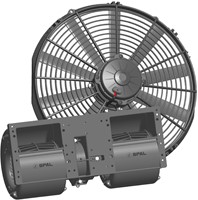
Cooling Fans for Automotive, Motorsport and Technical Applications
Electric cooling fans provide forced airflow when natural ventilation is insufficient. In automotive and motorsport applications, cooling fans are used to move air through radiators, condensers and heat exchangers, helping cooling systems transfer heat effectively.
At QSP Products, we offer a comprehensive selection of cooling fans and related components. Our range includes SPAL radiator fans, brushless cooling fans, in-line blowers, mounting accessories, T-adapters, thermostatic switches and fan control switches. These components can be used to build both conventional and electronically controlled cooling installations.
SPAL Radiator Fans for Engine and Liquid Cooling
SPAL develops electric cooling fans for automotive and professional thermal management applications. These fans are designed to generate airflow through radiators, condensers and other cooling surfaces.
Our range of SPAL radiator fans includes different diameters, airflow capacities and electrical configurations. This allows the fan to be selected according to radiator size, available installation space and the required cooling performance.
Various 12V models are available for passenger cars, race cars and performance vehicles. Our selection also includes 24V cooling fans for commercial vehicles, heavy-duty machinery and specialist applications.
Brushless Cooling Fans with Electronic Motor Control
Alongside conventional electric fans, we supply brushless cooling fans featuring electronically commutated motors without traditional carbon brushes.
This construction eliminates wear associated with carbon brushes and allows advanced electronic motor control. Depending on the model, fan speed may be controlled through PWM, analogue input signals or another compatible control interface.
Some brushless fan configurations also feature a feedback output, allowing suitable electronic systems to monitor fan operation.
These features are particularly useful in cooling systems where airflow must respond automatically to temperature changes or varying operating conditions. Always check the electrical connector, control interface and model-specific specifications before installation.
Puller and Pusher Radiator Fans
Airflow direction is an important consideration when selecting an electric radiator fan. The fan must be suitable for the intended mounting position relative to the radiator.
Puller Cooling Fans
A puller fan is generally installed behind the radiator and draws air through the cooling core. This arrangement is commonly used in engine cooling systems where sufficient space is available behind the radiator.
Pusher Cooling Fans
A pusher fan is installed in front of the radiator and pushes air through the cooling surface. This configuration can be useful when available space behind the radiator is limited.
Always verify the specified airflow configuration before installation. Not every fan is designed to operate interchangeably as a pusher or puller.
In-Line Blowers for Directed Airflow
In-line blowers are designed to move air through ducts, hoses and ventilation channels rather than being mounted directly against a radiator.
These fans can be used for directed airflow in automotive ventilation, technical compartments and custom air circulation systems.
When choosing an in-line blower, important specifications include connection diameter, airflow capacity, supply voltage and the pressure resistance of the ducting.
T-Adapters and Thermostatic Fan Switches
A thermostatic switch can be used to activate or deactivate an electric cooling fan automatically according to temperature. This allows additional airflow to be provided when coolant temperature reaches a selected threshold.
T-adapters provide a practical method of installing compatible temperature switches into coolant hose systems. The adapter must match the coolant hose diameter and the thread specification of the selected thermostatic switch.
When selecting a thermostatic switch, consider the switching temperature, electrical rating and intended fan control circuit.
Higher-current fans may require a suitable relay, while electronically controlled brushless fans may use a dedicated controller or PWM signal.
Fan Switches for Manual Operation
Manual fan switches allow the driver or operator to control fan operation through a suitable electrical circuit.
This type of control can be useful in race cars, rally vehicles and specialist installations where direct control of cooling fan operation is required.
Always check the switch's electrical rating. Where necessary, use a suitable relay and appropriate fuse protection rather than routing the full motor current through a switch that is not rated for the load.
SPAL Cooling Fan Mounting Accessories
Correct fan installation is essential for reliable operation and effective airflow through the cooling surface. We offer mounting accessories for SPAL cooling fans and associated installation requirements.
Before fitting a cooling fan, check the housing dimensions, mounting hole positions and available clearance around the rotating impeller.
The mounting arrangement should support the fan securely without introducing unnecessary mechanical stress into the radiator core.
A suitable fan shroud or airflow guide can also help distribute airflow more evenly across the radiator surface.
How to Select the Correct Electric Cooling Fan
Selecting the right cooling fan requires several technical characteristics to be considered together. Fan diameter and maximum airflow are important, but they do not provide a complete picture of cooling performance.
Important selection criteria include:
- Nominal supply voltage: 12V or 24V
- Puller or pusher airflow configuration
- Fan blade diameter and overall outside dimensions
- Available installation depth and mounting requirements
- Airflow capacity, expressed in m³/h
- Fan performance at the system's static pressure resistance
- Motor speed and electrical current requirements
- Conventional brushed or brushless motor technology
- Electrical connector and electronic control interface
A high maximum free-air rating does not automatically mean that a fan will perform best in every radiator installation. Pressure resistance created by the radiator core and airflow ducting affects the actual delivered airflow.
For demanding applications, we recommend comparing the manufacturer's pressure versus airflow performance curve with the requirements of the complete cooling system.
Combine Cooling Fans with Compatible System Components
A cooling fan is one part of a complete thermal management system. Effective operation also depends on the radiator, coolant hoses, connections and temperature control components.
Our product range includes components that can be used when building or modifying cooling installations, including silicone coolant hoses, aluminium tubes, hose connectors and hose clamps.
By selecting compatible components, a reliable cooling installation can be developed for automotive, motorsport and industrial applications.
Frequently Asked Questions About Cooling Fans
What is the difference between brushed and brushless cooling fans?
A conventional brushed fan uses carbon brushes for electrical motor commutation. A brushless cooling fan uses electronic commutation without conventional carbon brushes. This eliminates brush wear and often provides additional options for electronic speed control.
What is the difference between puller and pusher fans?
A puller fan is installed behind the radiator and draws air through the cooling core. A pusher fan is installed in front and pushes air through the radiator. The correct configuration depends on the intended airflow direction and available installation space.
Can I connect a 24V fan to a 12V electrical system?
A 24V fan is designed for a compatible 24V electrical supply. Reliable operation requires the supply voltage to match the fan specifications. Always choose the appropriate voltage for the electrical system.
How do I determine the required radiator fan airflow?
Required airflow depends on heat output, radiator dimensions, cooling core resistance and operating conditions. The manufacturer's fan performance curve helps determine the available airflow at different levels of static pressure.
Should I use a thermostatic switch or a manual fan switch?
A thermostatic switch allows automatic temperature-dependent fan operation. A manual fan switch provides direct control by the driver or operator. The appropriate choice depends on the desired control system and the fan's electrical requirements.
Can I control a brushless cooling fan with a standard switch?
This depends on the specific fan model. Many brushless fans feature integrated electronics and require a compatible PWM or enable signal. Always follow the manufacturer's wiring and control instructions.
Cooling Fans and Accessories from QSP Products
Explore our range of SPAL radiator fans, brushless cooling fans, in-line blowers, thermostatic switches, T-adapters and mounting accessories for automotive, motorsport and industrial applications.
Compare the available product categories and technical specifications to select the correct cooling fan for your installation. With compatible mounting accessories and electrical control components, you can build a cooling system suited to your performance requirements.